It’s time to address the elephant in the room, and it’s a topic that seems to confuse a lot of consumers: Why is ‘Handmade in the USA’ higher priced? Especially when it is listed right next to mass-produced products or items handmade in other countries. Let me break it down for you.
Overall Production Costs and the Cost of Living
Before anything can be created—regardless of the product type—you need materials. Even mid-grade materials are sourced at a much higher cost within the USA. While we can order from overseas companies, we then face significant shipping fees, import duties, and long wait times. Generally speaking, the American market carries a much higher baseline cost than many overseas manufacturing hubs.
Then, we have to factor in the cost of living.
Unless someone is creating handmade products as a hobby—just to give away, keep for themselves, or sell to recover the bare cost of materials—a living wage must be factored in. For an artisan who has turned “Handmade in the USA” into a professional business, there are overhead costs and the basic necessity of earning enough to survive (and hopefully, thrive!).
This means calculating an hourly rate for every piece. You wouldn’t be okay working for nothing, would you? Of course not! You are a clever human being. The same logic applies to artisans, crafters, and makers. That base hourly wage can range anywhere from a local minimum wage to a very reasonable $30 per hour or more.
I’ll explain more about why that rate varies so much in just a minute.
An Hourly Wage: The “Effort and Craftsmanship” Tax – Handmade in the USA edition!
I know that sounds like a strange way to phrase it, but if you think about it, you aren’t just paying for materials arranged in a pleasing way. You are paying for the time, effort, and specialized craftsmanship that the maker has poured into the piece.
Depending on how long someone has been honing their skills, how proficient they are, and how well-known they’ve become, the wage scale shifts. When you factor in the artisan’s location and their specific production capacity, a very different price point begins to emerge.
The Geography of Pricing For example, consider an artisan living in California, where the cost of living is extremely high, versus someone in the Midwest or rural East Coast. In California, as of January 1, 2026, the minimum wage is $16.69 an hour—and that is still not considered a “living wage” in many cities. In comparison, the minimum wage in Pennsylvania is still $7.25 an hour, a rate that hasn’t changed since 2009 despite the skyrocketing cost of living.
For someone living in PA (like myself), an hourly rate of $10 to $15 is a modest starting point, while someone in California would need at least $20 to $25 an hour just to cover their base necessities.
Experience and Evolution As I mentioned earlier, skill, experience, and brand recognition all come into play. I am still building my brand, but my experience level ranges from 15 years in intricate beadwork to nearly 50 years in crochet and art (a journey I started as a child).
As for my skill level? It is ever-evolving. I don’t think I’ll ever call myself a “Top Tier Master,” because to me, that implies I have nothing left to learn. However, an artisan with 50 years of experience and a high “known factor” could easily justify charging five to ten times my current rate.
The physical strain on the maker’s body
This next part applies to every artisan around the globe, with perhaps one major difference: healthcare costs in the good old USA. It’s astronomical, and most of us can’t afford insurance.
In order to demonstrate this for those of you who are not in an occupation that requires endless hours of sitting in the same spot, possibly hunched over for hours upon time, I’d like you to do something for me.
Set a timer for 2 hours (just two hours) and sit down at a table. Now lean forward as if you were trying to see something very small, and move your hands in a “hand-sewing motion,” as well as a picking up something small motion. Do that without stopping for the next two hours.
On average it takes me between four to ten hours to create a piece of beaded jewelry, depending on what I create. During that time, I will sit in that position, with only a quick break to use the restroom, or do a quick stretch.
My back, my buttocks, my hands, my neck—all of those are in high strain for the entire time. When working with 11/0 Delica beads or even 8/0 round beads, there is an immense amount of eye strain as well.
Crocheting requires sitting still in the same position for several hours at a time, too. Cramps are not unusual.
I know it all sounds so simple, but that is like telling a secretary or desk clerk that their back and wrists are not constantly sore.
Go ahead, give it a try, and now think about this: this is something we do every day (at least I do) for ten to 12 hours a day.
So yes, that goes into compensation as well. See hourly wage above.
Most of the time we don’t even charge what we should – a personal example.
Since I am still in the brand building stage, and am just now getting my first online sales, what I can charge is dictated by “Loss leader” economics.
Meaning I need to offer things way below what they are actually worth, in order to entice customers to take a chance on purchasing from someone as of yet to be discovered.
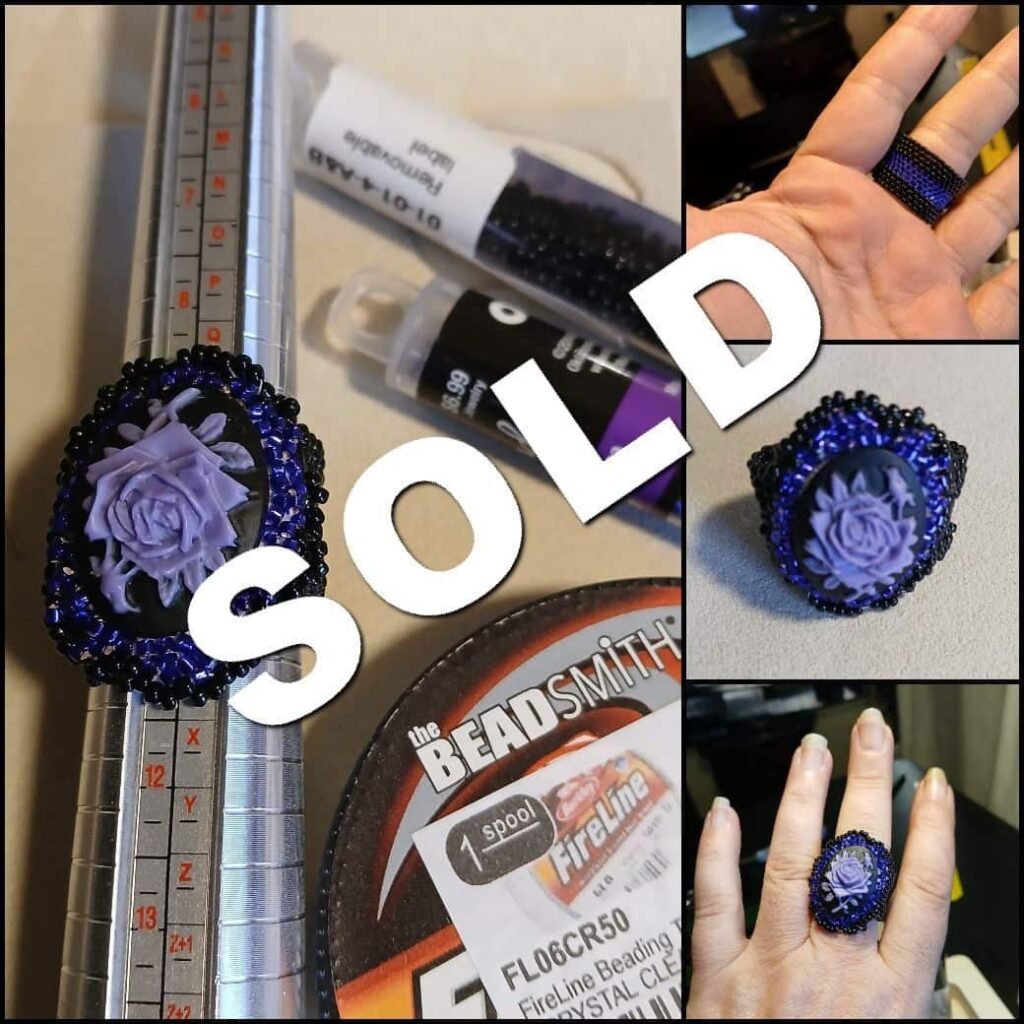
This elegant beaded ring just sold on my eBay store for $49.99 + S&H. (Waits for the sticker shock gasps…)
Now let me break it down for you.
Material costs: Roughly $6.00 (Wow, I’m getting a really big profit, right? WRONG). Production time: Since I was working with Delica beads here, and had to create the top focal first, plus add all the backing, then do the band and attach it, this ring took me about 5 1/2 hours of focused work to create. So let’s say I would charge $10 an hour—we are already looking at a minimum of $56. Time and cost of packaging the product is about another $5.00.
Now let me tell you, out of those $49.99 I charged, I am only getting about $32 (Sellers Fees, Promotional Fees, etc.).
Let’s break that down: Money to me: $32. Take away $5.00, now we are at $27. Subtract the $6.00 material cost and we are at $21. Divide that by 5.5 and I made about $3.81 an hour. I guarantee you, you wouldn’t be willing to work for that.
Handmade in the USA – Heritage and Heirloom Treasures
The value of each of the “Handmade in the USA” pieces you see for sale isn’t even just in the cost, the production time, or that bit of soul that each of us makers put into our creative works. You are receiving a bit of heritage with it. Handcrafting is a dying art form that some are trying to revive now.
In a culture that has shifted to the mass-production and “easy” mentality, these handmade treasures carry a bit of heritage skills, cottagecore aesthetic, and yes, rebellion against the machine in them.
If you treat them right, they become heirloom pieces. They carry our creativity, our skills, our pain, and our determination to keep human skills alive. They carry traditions that are generations old, and if we forget about them, they will be gone forever. Consider us the keepers of the old ways, the remembrance, while carrying it forward with our own personal flair into the future.
A call to action and mental shift
The next time you walk past a vendor display or browse an e-commerce store where “Handmade in the USA” products are offered, pause and think about all you have learned here today.
Allow yourself to see beyond the sticker price to the true value of what is on offer. Instead of trying to bargain with the artisan, appreciate their creativity, effort, time, and craftsmanship.
Think of yourself as a valued supporter of handmade small businesses, which have a hard enough time in today’s economy to survive. The mental shift from consumer to supporter of someone’s dream, heritage, and livelihood is a massive difference in the way you’ll see what is before you.
If you are going to spend your hard-earned money on a luxury item (and handmade is luxury), make it mean something. For you, and for the Artisan / Maker you purchase from.
I’d like to invite you to visit my eBay Store now, where all of my handmade treasures are waiting for their new home and friend. Browse in the different categories I have available for you, and if you find something you love—don’t hesitate to buy it.
I believe in supporting worthy causes myself. Even though I am just at the starting line of building my brand, I have several active listings in which I donate a percentage of my sales price to worthy causes. This allows us to make a difference together.
Thank you, as always, for visiting with me and reading.
May you forever be blessed!
Artisan Regina L.
Return To Home Page / Browse My eBay Store / Read My About Me Page / Find Me on Social Media
The post that I have just read is very clear and informational… reading this post is very fun to read.